How NANDmind works
Mixture-of-experts inference that reads weights straight from flash
The problem: memory, not compute
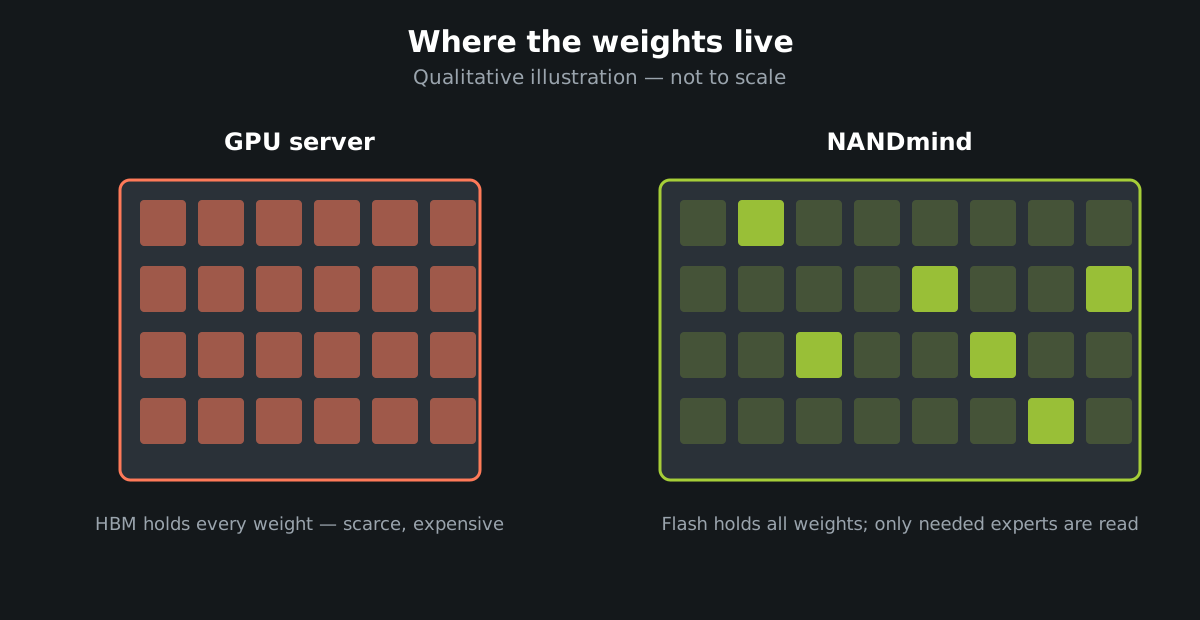
Frontier open models are mixture-of-experts: hundreds of billions to trillions of parameters, of which only a small share is used for each token. Serving them on GPUs means buying enough HBM to hold every weight, and HBM and GPUs are in short supply.
Most of that memory sits idle at any moment. What matters is reading the right experts fast enough — and that is a job flash can do.
The approach: stream experts from flash
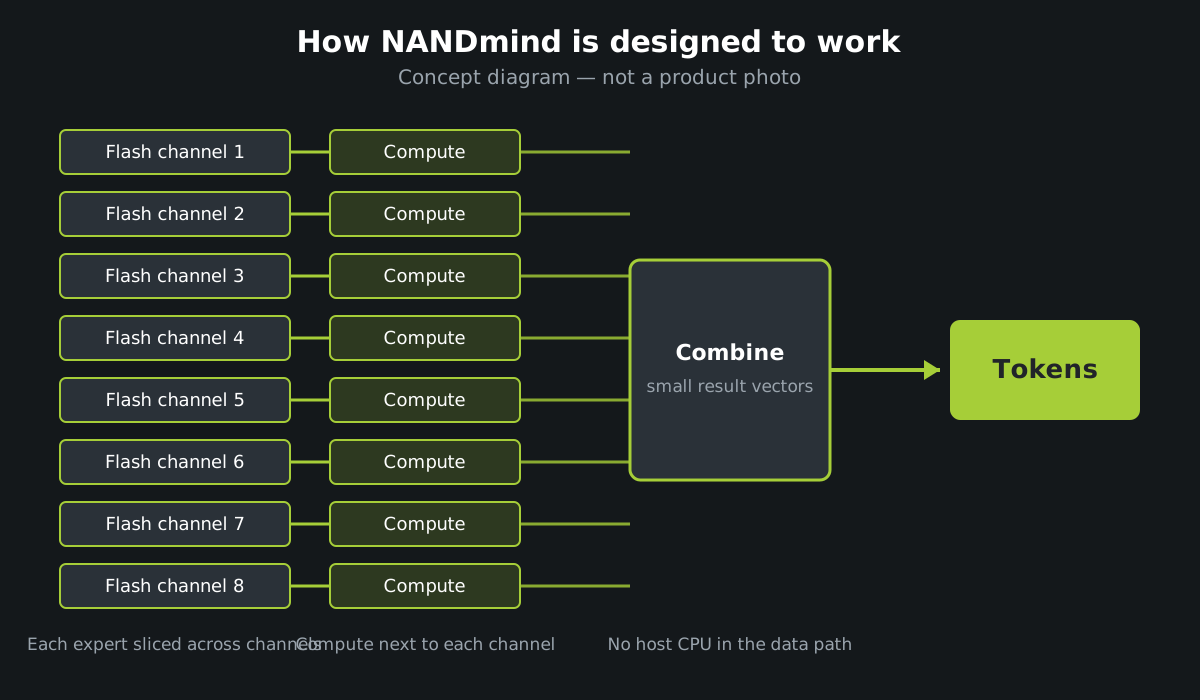
NANDmind slices every expert across many independent NAND flash channels and puts compute next to each channel. When the router picks experts for a token, all channels read their slices in parallel, and only small result vectors travel between chips. No host CPU, file system or flash translation layer sits in the data path. The first version uses FPGAs; a custom chip comes later.
Design principles
Six ideas that make flash fast enough for frontier models:
Experts sliced across channels
Compute next to the flash
No file system in the data path
Hot experts copied for balance
Wear-aware reading and refresh
Scale by adding modules





FAQ
Not yet. NANDmind is in development: we are validating the design on a trace-driven simulator, and two US patent applications are filed. You can reserve a slot in the first batch now, with no payment.
It is designed for mixture-of-experts models from about 600B to 3T parameters, such as DeepSeek-V3-class (671B) and Kimi K2-class (1T) models. Dense models are not the target.
Our current estimate for a DeepSeek-V3-class model on one module is about 17 tokens per second per stream. This is a calculation, not a measurement; we will publish simulator results. GPUs are faster per stream; NANDmind targets cost per token and availability.
Reads wear flash far less than writes, but very frequent reads disturb nearby cells. NANDmind spreads reads over copies of hot experts and refreshes blocks in the background. By our estimates the flash lasts from 1.5 years in the worst case to many years, depending on the model and layout.
A GPU server must hold the whole model in HBM, the scarce and expensive part. A workstation with unified memory can run a quantized 671B model, but stops at its memory size. NANDmind adds capacity by adding flash modules, up to 3T-parameter models.
No. In an on-premises deployment, weights, prompts and outputs stay on your hardware.
Nothing. Reserving a slot is free and non-binding. To go further, we sign an NDA and a letter of intent. Deposits will open only after the prototype.
Yes. We talk with flash and controller makers about licensing and co-development — see Partners.